DHIS2 Training for the Action aMNH Program — Surkhet, Nepal
Date: 6–8 May 2026
Venue: Birendranagar, Surkhet
Program: Action adolescent Maternal Newborn Health (Action aMNH)
Participants: Program Coordinators, Technical Coordinators, Field Officers, Technical Officers, MEAL Officers, and SCI staff
Background
The Action adolescent Maternal Newborn Health (Action aMNH) program is a multi-partner initiative focused on improving maternal and newborn health outcomes across Surkhet and surrounding districts. As part of a commitment to strengthening Monitoring, Evaluation, Accountability, and Learning (MEAL) systems, the program took a significant step in May 2026 — transitioning from KoboToolbox to DHIS2 as the primary platform for program data collection and monitoring.
Hello World was engaged to facilitate this transition, providing a structured 3-day training to equip all program staff and implementing partners with the skills to use DHIS2 confidently.
Why the Shift from KoboToolbox to DHIS2?
KoboToolbox has served humanitarian and development programs well for rapid data collection. However, as the Action aMNH program scaled and the need for longitudinal tracking, indicator disaggregation, and integration with national health data systems grew, DHIS2 emerged as the more suitable platform. Key drivers behind the transition:
- Longitudinal monitoring: DHIS2 tracks data across periods and organizational units, enabling trend analysis that KoboToolbox is not designed for
- Integration with Nepal's national HMIS: DHIS2 is already the national health management information system — aligning program data with national reporting reduces duplication
- Role-based access control: Different users at facility, district, and program level can see and enter only the data relevant to their role
- Real-time dashboards: Program managers and MEAL officers get live visibility into field reporting without waiting for data exports
Training Overview
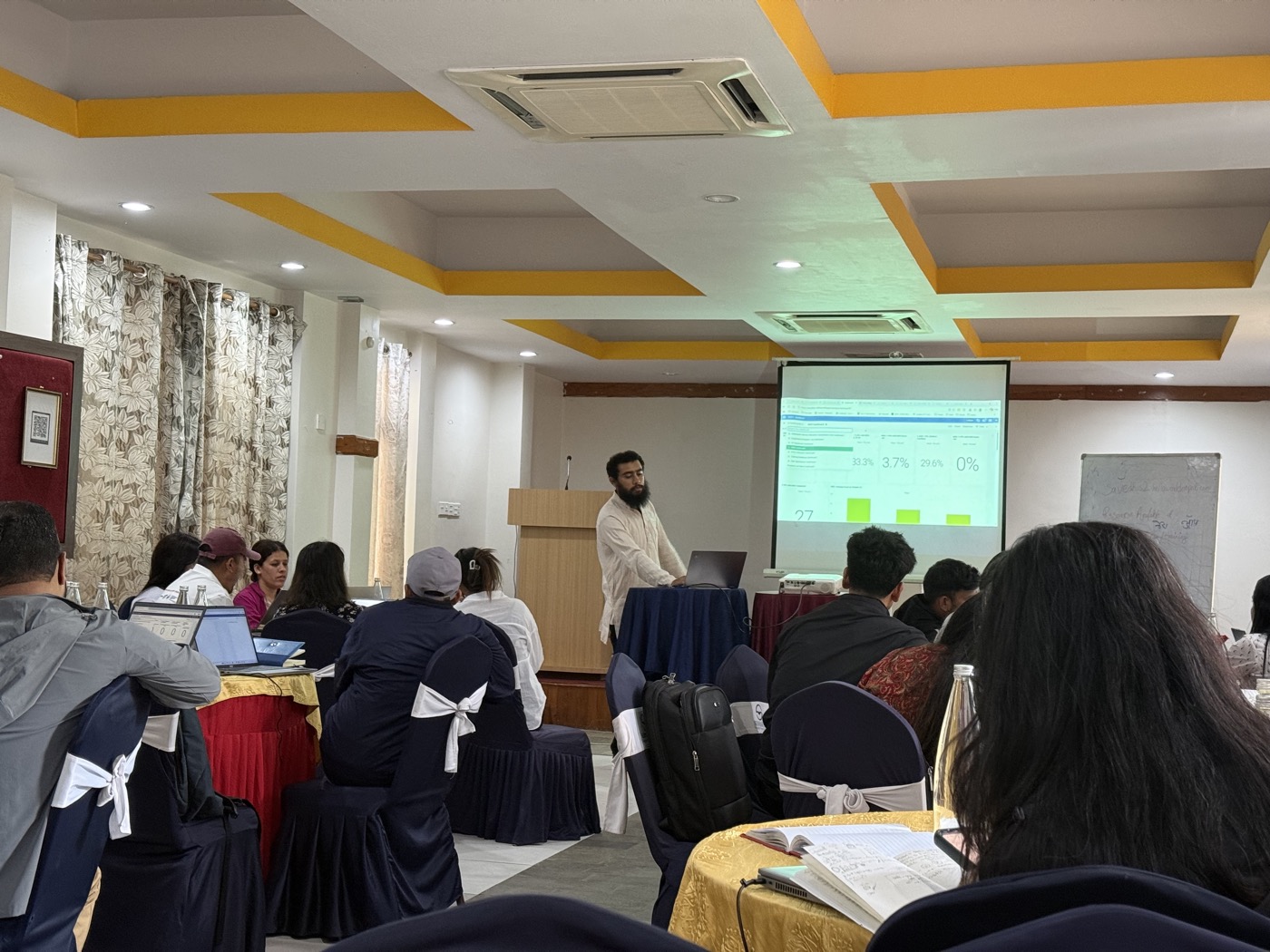 Hello World consultant facilitating the DHIS2 training session for Action aMNH program staff in Birendranagar, Surkhet
Day 1: DHIS2 Fundamentals, Navigation, and Data Entry
The first day focused on building foundational understanding and practical data entry skills.
Opening and Accountability Sharing
The training opened with an orientation session led by the Manager for Health and Nutrition, covering program objectives and accountability structures. The MEAL Coordinator walked participants through the program's budget accountability framework — ensuring all staff understood what the program data would be used for and why accurate reporting matters.
Introduction to DHIS2
Hello World consultants led an in-depth introduction to DHIS2, covering:
- What DHIS2 is and how it is used for program monitoring and MEAL
- Key concepts: organizational units, data elements, datasets, periods, and indicators
- How the Action aMNH program is configured within DHIS2
- The shift from Kobo forms to DHIS2 datasets — what changes and what stays the same
User Roles and Access
A critical session covered how DHIS2 manages user access. Participants learned:
- How user roles and sharing settings determine what each person can see and do
- The difference between data entry users, analytics users, and system administrators
- How to create and manage user accounts for implementing partners including KIRDARC
- Best practices for keeping user accounts secure and current
System Navigation and Data Entry via Capture App
Afternoon sessions put participants in front of live DHIS2 instances. Using the Capture App, field officers and MEAL staff practiced:
- Navigating DHIS2 apps and the main menu
- Understanding datasets, data entry forms, and reporting periods
- Entering program data and saving drafts vs. completing submissions
- Using the Capture App on both desktop and mobile devices
Day 2: Data Entry in Practice, Dashboards, and Reporting
Day 2 moved from concepts to sustained hands-on work. With the fundamentals from Day 1 in place, participants spent the day actually using DHIS2 — entering program data, exploring dashboards, and generating reports.
Data Entry — Going Deeper
Building on the Capture App introduction from Day 1, participants worked through real program datasets. This session focused on:
- Entering complete monthly datasets for their assigned organizational units
- Understanding mandatory vs. optional fields and how incomplete submissions affect reporting completeness
- Handling common data entry errors — wrong period selection, duplicate entries, and how to correct them
- The approval workflow: submitting data for review vs. marking it as complete
Field officers practiced entering data that mirrored their actual monthly reporting responsibilities, using a test instance loaded with the Action aMNH program structure.
Using the DHIS2 Dashboard
The dashboard session was a highlight for program managers and MEAL officers. Participants learned:
- How to navigate pre-built dashboards configured for the Action aMNH program
- Reading aggregate charts, scorecards, and maps showing performance by facility and district
- Understanding how dashboard data links directly to what field officers enter — reinforcing the connection between data entry quality and what managers can see
- Saving and sharing dashboards with team members
Seeing their own program data visualized in real time — with facility-level breakdowns and trend lines — was a visible turning point for many participants.
Reporting — Standard and Custom
The afternoon covered DHIS2's reporting tools:
- Running standard reports and downloading them as PDF or Excel for program reporting needs
- Using the Data Visualizer app to create custom charts and pivot tables
- Reporting completeness views — which facilities have submitted, which are overdue
- Scheduled reporting: understanding how DHIS2 can be configured to send automated reminder emails when reporting deadlines approach
Day 3: System Overview, Reporting for Decision-Making, and Wrap-Up
The final day took a step back from individual features to focus on how the whole system serves the program's MEAL objectives — and how participants would use DHIS2 sustainably after returning to the field.
Program Monitoring and MEAL Use Cases
Hello World facilitators walked through how DHIS2 supports the full MEAL cycle for the Action aMNH program:
- Monitoring: Tracking data entry completeness and timeliness across facilities and partners
- Evaluation: Using aggregated indicators over time to assess program progress against targets
- Accountability: Audit logs showing who entered what data and when — supporting program accountability to donors and communities
- Learning: Identifying facilities with consistently strong data quality and performance as learning sites; flagging outliers for investigation and support
Reporting for Program Purposes
Participants worked through the specific reports most relevant to their roles:
- MEAL Officers: completeness reports and indicator trend reports for donor submissions
- Program Coordinators: district-level performance summaries and outlier identification
- Field Officers: their own facility's data history and validation status
A guided session walked through generating a sample program report — pulling data from DHIS2, interpreting the key indicators, and drafting the narrative context that turns numbers into program learning.
Open Q&A and Practical Planning
The final session was structured as an open forum. Participants raised real scenarios from their work — data submission conflicts between field officers and supervisors, what to do when internet is unavailable at month-end, how to handle retroactive corrections — and Hello World facilitators worked through each one live.
The day closed with each participant committing to a concrete next step: creating their DHIS2 user account, entering their first real dataset, or identifying a colleague to train using the materials from the workshop.
Who Attended
The training brought together 20+ staff from across the program ecosystem:
- SCI staff — Program and Technical Coordinators, Health and Nutrition Manager, MEAL Coordinator
- KIRDARC staff — MEAL officers and field officers from the implementing partner
- Field-level staff — Technical Officers and Field Officers who will be primary data entry users
Having all levels of the program hierarchy in the same room created valuable alignment — field officers understood why data quality matters to MEAL officers, and managers understood the practical constraints their field teams face.
Key Takeaways from the Field
Participants arrived with varying levels of digital literacy and prior experience with health information systems. By the end of Day 1, the room had shifted noticeably — field officers who had never logged into DHIS2 were navigating datasets and entering test data with growing confidence.
Several themes emerged from participant feedback:
On the KoboToolbox to DHIS2 transition:
"In Kobo, we filled one form and submitted. In DHIS2, we need to understand which dataset belongs to which period. Once we understood that, it became much clearer."
On user roles:
"Knowing that our partner accounts will only see their own facilities' data makes us more comfortable sharing access broadly."
On the Capture App:
"The mobile app works even on our 3G connection in the field. That was our biggest worry — whether it would work outside Surkhet town."
DHIS2 Configuration for Action aMNH
The DHIS2 instance was configured by Hello World prior to the training to reflect the Action aMNH program's data requirements:
- Organizational hierarchy mapped to program implementation geography — from national level down to facility and community points
- Data elements and datasets aligned with program MEAL indicators for adolescent and maternal newborn health
- User groups set up for SCI, KIRDARC, and other implementing partners with appropriate sharing levels
- Dashboards pre-built to give MEAL officers instant visibility into reporting completeness and key program indicators
Lessons for Future DHIS2 Training Programs
Running DHIS2 trainings in field settings across Nepal has taught Hello World several things that hold true regardless of program context:
1. Anchor everything to their current workflow. Participants engage more deeply when you explain DHIS2 features in terms of what they already do — "this dataset is like your monthly Kobo form, but it lives here permanently and auto-calculates indicators."
2. Hands-on time is non-negotiable. No amount of presentation slides replaces 30 minutes of participants actually creating users and entering data. Demonstrations are useful; practice is transformative.
3. User roles deserve more time than they usually get. In almost every training, the user roles and access session generates the most questions — and the most "aha" moments. Who can see what, and why, is the question that unlocks confidence in the system.
4. Field connectivity must be tested before the training, not during it. We always arrive the day before to test VPN access, mobile data speeds, and browser compatibility on participant devices. Problems discovered on Day 1 morning derail momentum.
5. Create a local champion network. Training 20 people is only valuable if some of them become go-to resources for their colleagues afterward. We identify potential champions during the training and give them supplementary material and direct contact for follow-up.
What Comes Next
Following the 3-day foundational training, the Action aMNH program will move into a supervised data entry period where Hello World provides remote support as field teams submit their first real datasets. A follow-up refresher training is planned for Month 3 to address questions that emerge from live use and to introduce analytics and dashboard features.
If you are running a health program in Nepal and considering a transition to DHIS2 — or want to strengthen your existing DHIS2 implementation — get in touch with Hello World. We have deep experience with program-specific DHIS2 configurations and have trained hundreds of field staff across Nepal's health sector.
Hello World IT Solutions is a Kathmandu-based health informatics company specializing in DHIS2 implementation, OpenHIM integration, FHIR standards, and custom health software development across Nepal and South Asia.